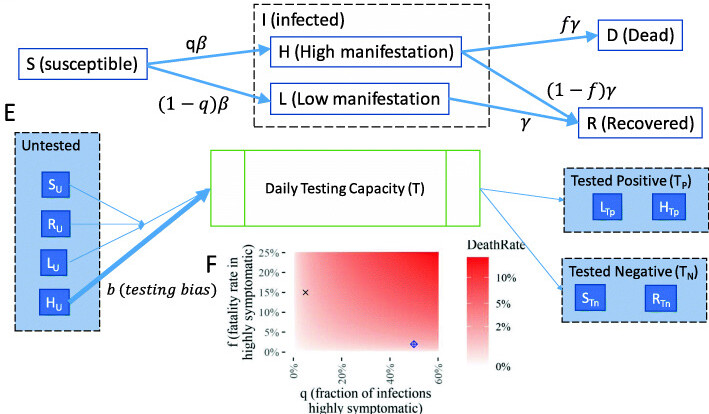
Modeling testing bias in an epidemic. Panels A and B relate observed fatality rates to testing, panel C is a standard susceptible-infected-recovered-dead model, and panels D to F extend it with high- and low-symptom groups and a testing capacity that favors the more symptomatic. Source: Suhail et al., BMC Medical Research Methodology (2021), CC BY.
The full description of this project, with its approach, findings and figures, is on the Suhail Lab website.
Background: The disease burden of SARS-CoV-2 as measured by tests from various localities, and at different time points present varying estimates of infection and fatality rates. Models based on these acquired data may suffer from systematic errors and large estimation variances due to the biases associated with testing. An unbiased randomized testing to estimate the true fatality rate is still missing. Methods: Here, we characterize the effect of incidental sampling bias in the estimation of epidemic dynamics. Towards this, we explicitly modeled for sampling bias in an augmented compartment model to predict epidemic dynamics. We further calculate the bias from differences in disease prediction from biased, and randomized sampling, proposing a strategy to obtain unbiased estimates. Results: Our simulations demonstrate that sampling biases in favor of patients with higher disease manifestation could significantly affect direct estimates of infection and fatality rates calculated from the numbers of confirmed cases and deaths, and serological testing can partially mitigate these biased estimates. Conclusions: The augmented compartmental model allows the explicit modeling of different testing policies and their effects on disease estimates. Our calculations for the dependence of expected confidence on a randomized sample sizes, show that relatively small sample sizes can provide statistically significant estimates for SARS-CoV-2 related death rates.
Semin Orthod
Artificial Intelligence for radiographic image analysis
Shivam Mehta, Yasir Suhail, John Nelson, and Madhur Upadhyay
Automated identification of landmarks on lateral cephalogram and cone-beam computed tomography (CBCT) scans can save time for the clinicians and act as a second set of eyes for analysis of radiographic images in diagnosis and treatment planning. Several machine-learning techniques have been utilized for this purpose with varying accuracies. However, high degree of variability in the clinical presentation of orthodontic patients, limitations of the algorithms, lack of labelled data, high compute power, etc. are some drawbacks that have limited robust clinical application of such techniques. In recent years, artificial neural networks like deep learning and more specifically deep neural networks are making significant inroads in the true adoption of this technology. YOLOv3 and Single Shot Multibox Detector are some of the deep learning algorithms that have shown promising results. This paper is a theoretical review of the evolution of these technologies and the current state of the art in orthodontic image analysis.
2020
Bioengineering
Machine learning for the diagnosis of orthodontic extractions: A computational analysis using ensemble learning
Yasir Suhail, Madhur Upadhyay, Aditya Chhibber, and Kshitiz
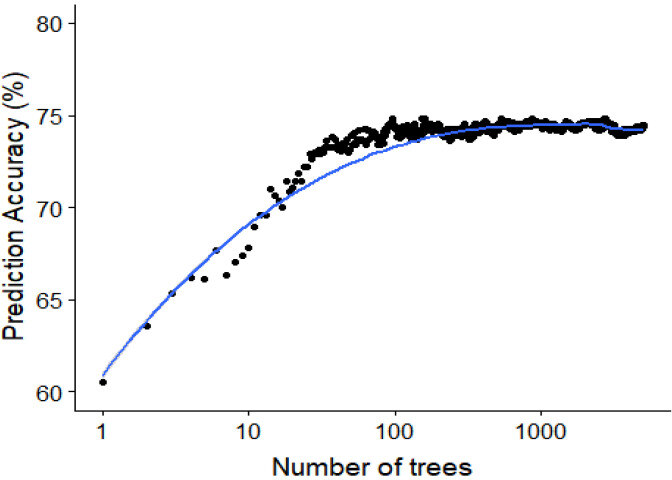
Extraction of teeth is an important treatment decision in orthodontic practice. An expert system that is able to arrive at suitable treatment decisions can be valuable to clinicians for verifying treatment plans, minimizing human error, training orthodontists, and improving reliability. In this work, we train a number of machine learning models for this prediction task using data for 287 patients, evaluated independently by five different orthodontists. We demonstrate why ensemble methods are particularly suited for this task. We evaluate the performance of the machine learning models and interpret the training behavior. We show that the results for our model are close to the level of agreement between different orthodontists.
2008
Genome Res
Finding friends and enemies in an enemies-only network: A graph diffusion kernel for predicting novel genetic interactions and co-complex membership from yeast genetic interactions
Yan Qi, Yasir Suhail, Yu Yi Lin, Jef D. Boeke, and Joel S. Bader

 Incorporating and addressing testing bias within estimates of epidemic dynamics for SARS-CoV-2BMC Medical Research Methodology, 2021


 Machine learning for the diagnosis of orthodontic extractions: A computational analysis using ensemble learningBioengineering, 2020


